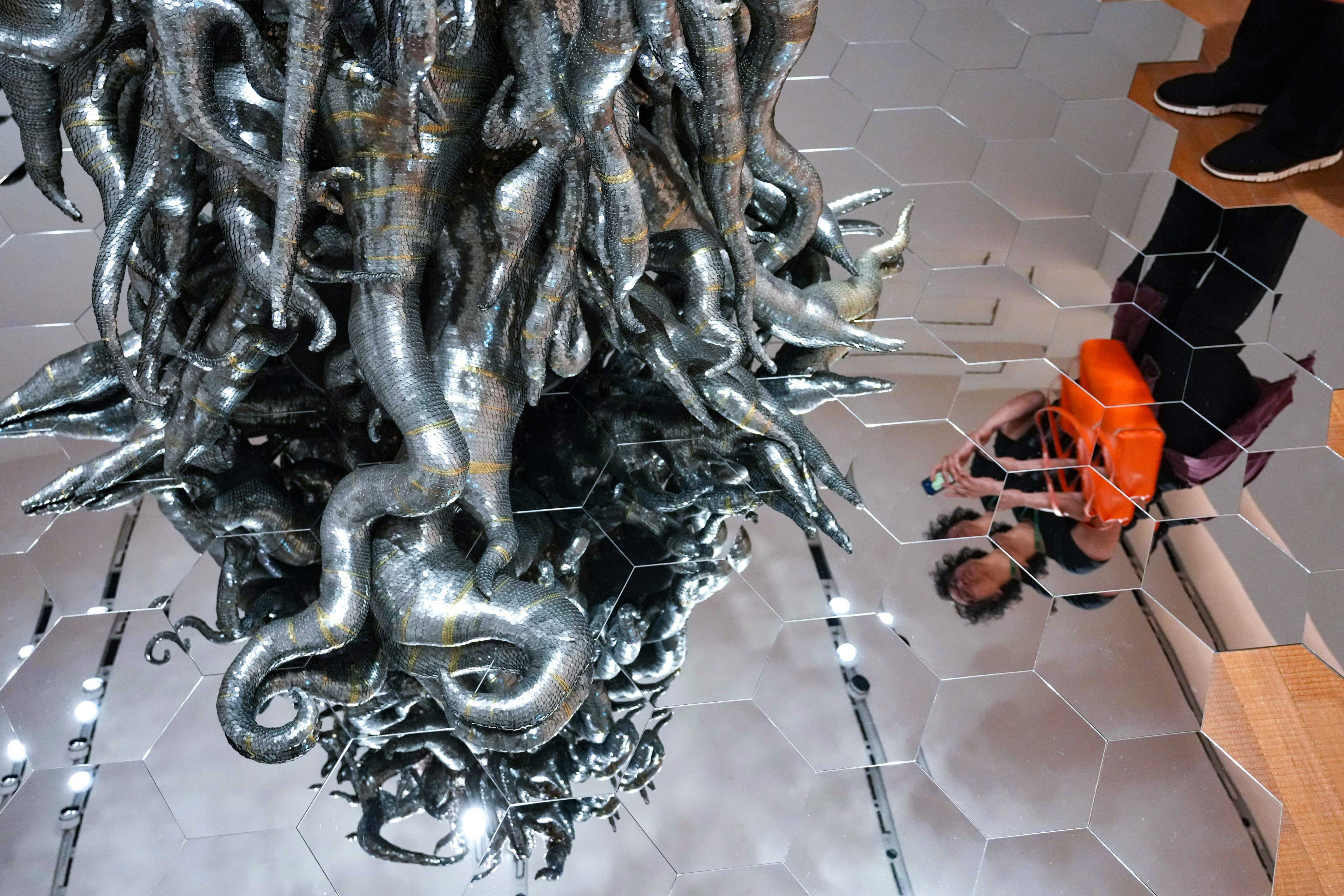
Upon entering the M+ museum’s West Gallery, you will encounter a sprawling, immersive landscape of sculptural installations. From a bathtub filled with black ink to a spiralling labyrinth of crystal beads and mirrors, key pieces by South Korean contemporary artist Lee Bul capture the destruction of once-beautiful, failed utopias.
They are among the more than 200 works on display in the museum’s latest special exhibition, “Lee Bul: From 1998 to Now” – a journey that examines the friction between humanity and technology.
Lee was born in 1964 in South Korea under the military dictatorship of Park Chung-hee, who seized power in a coup. Lee debuted in the late 1980s with performance art works that were equal parts captivating and provocative, exploring the relationship between the body and society in South Korea at the time.
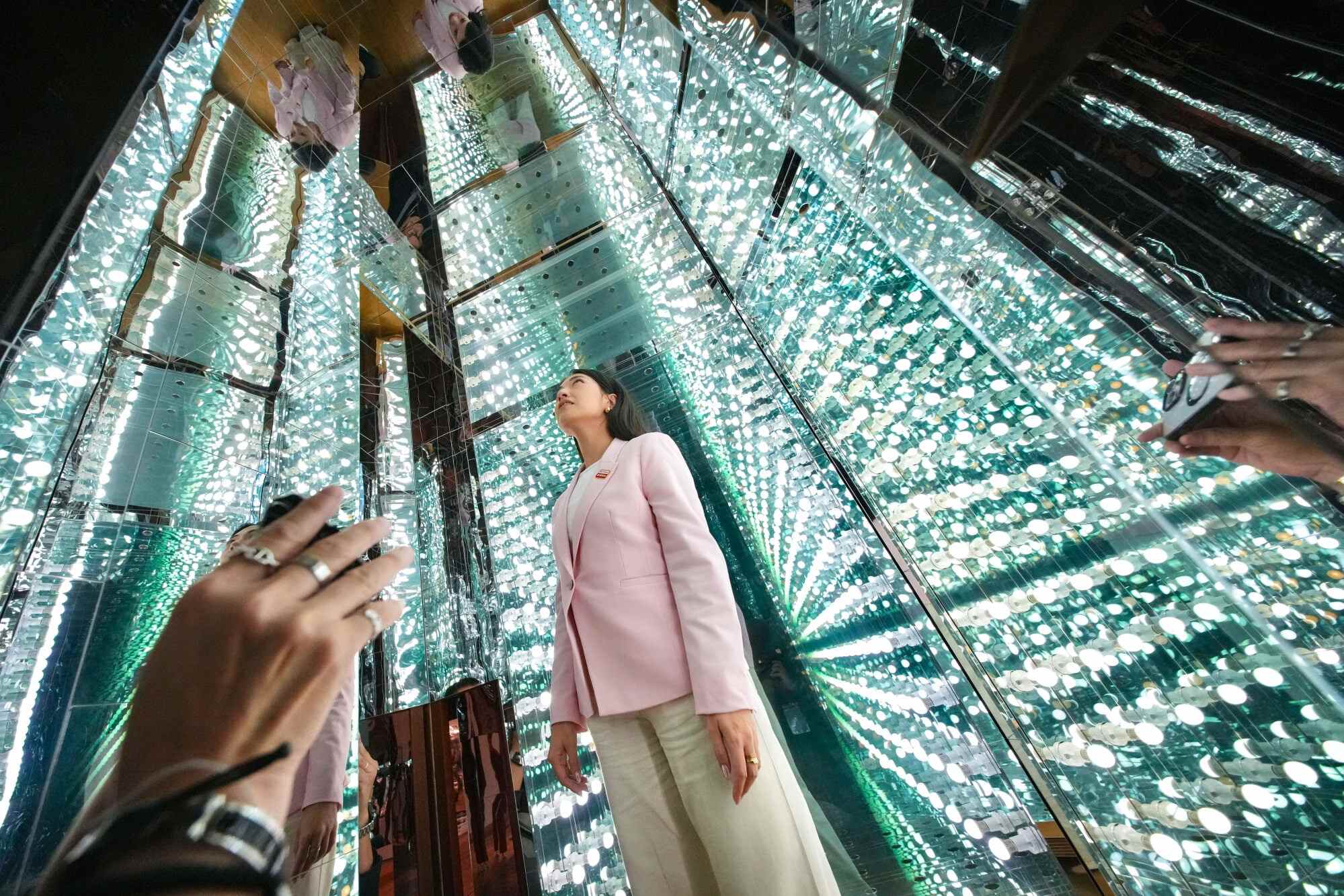
The new retrospective follows her art journey from the late 90s to now, highlighting her unique bridging of human anatomy and machine logic. The sculptures feel particularly urgent, mirroring anxieties about the rapid rise of artificial intelligence (AI).
Organised into three thematic sections, the exhibition considers a power struggle between humanity and technology. It opens with Lee’s Mon grand récit series – a pivotal collection of immersive installations, drawings and sculptures initiated in 2005 that marked her shift towards investigating architecture and the concept of modernity.
The special exhibition in three parts
The first section invites visitors to reflect on narratives surrounding modernity as a philosophical and historical topic. It also looks at failed utopias.
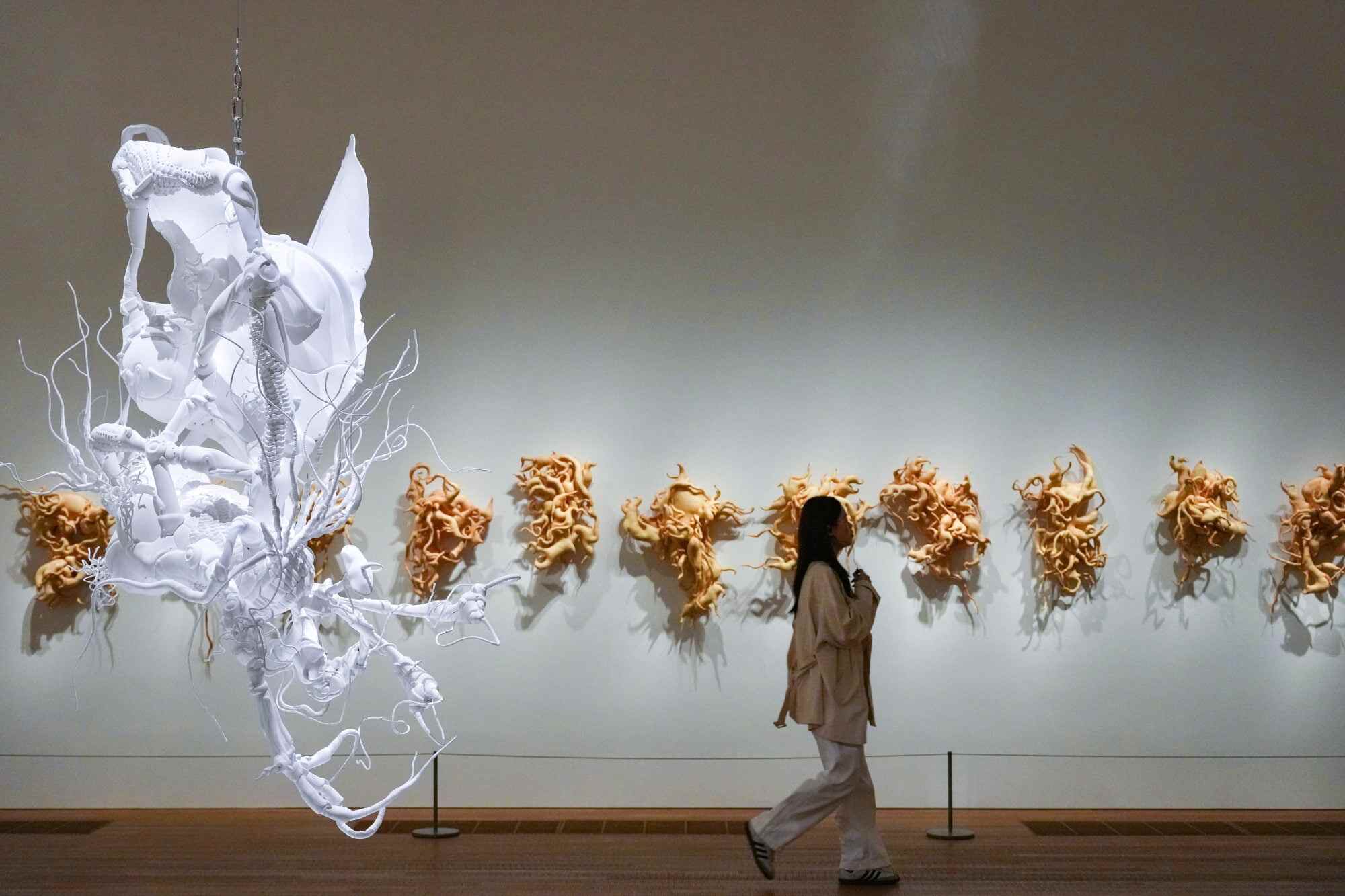
The installations are complemented by two-dimensional artworks, selected from Lee’s Perdu series (2016–ongoing) and Willing to Be Vulnerable – Velvet series (2016–ongoing). Incorporating both organic and industrial materials, the works touch on history, politics, personal memory and modern society.
In the second section, “Body and Technology: Cyborgs and Anagrams”, you will find some of Lee’s earlier works from the 1990s and 2000s, including the influential Cyborg and Anagram series that established her internationally.
In the Cyborg series, Lee’s three-dimensional silicone, robotic sculptures reconfigure classical statues with futuristic enhancements. Humanity’s enduring desire to transcend physical limitations with technology shines here.

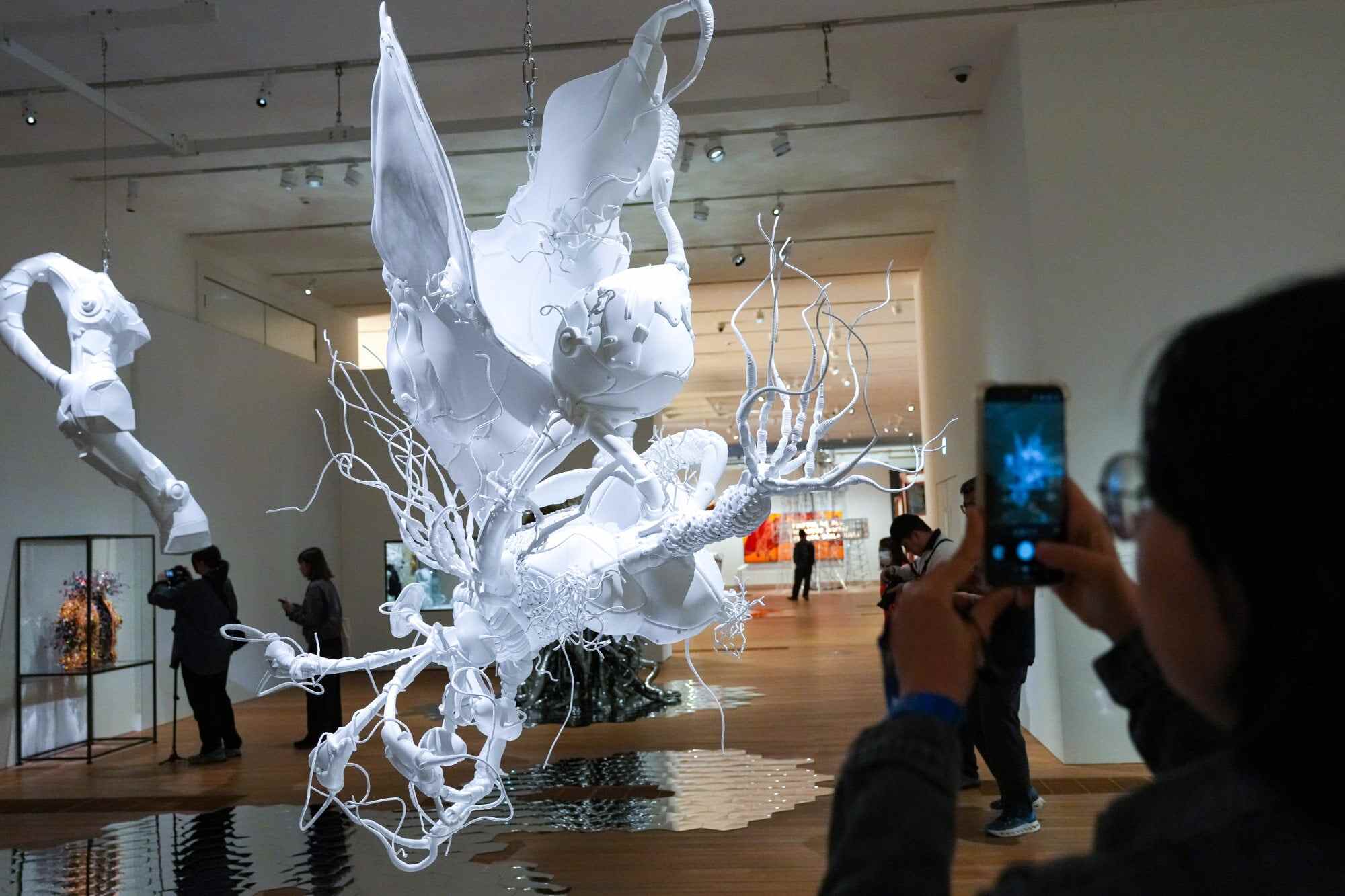
The Anagram series merges natural and mechanical elements as it questions conventional ideas of perfection. Drawing upon wide-ranging references from critical theory, art history and science fiction, Lee explores gender and beauty in a world of advancing technology.
A highlight of the survey is Heaven and Earth (2007), a fantastical installation featuring a bathtub filled with black ink, surrounded by a white landscape of broken tiles. It is inspired by Mount Paektu, a huge, sacred volcano that straddles the border between North Korea and China. It is regarded as the birthplace of the first king of Joseon, the first Korean kingdom, according to the region’s mythology.
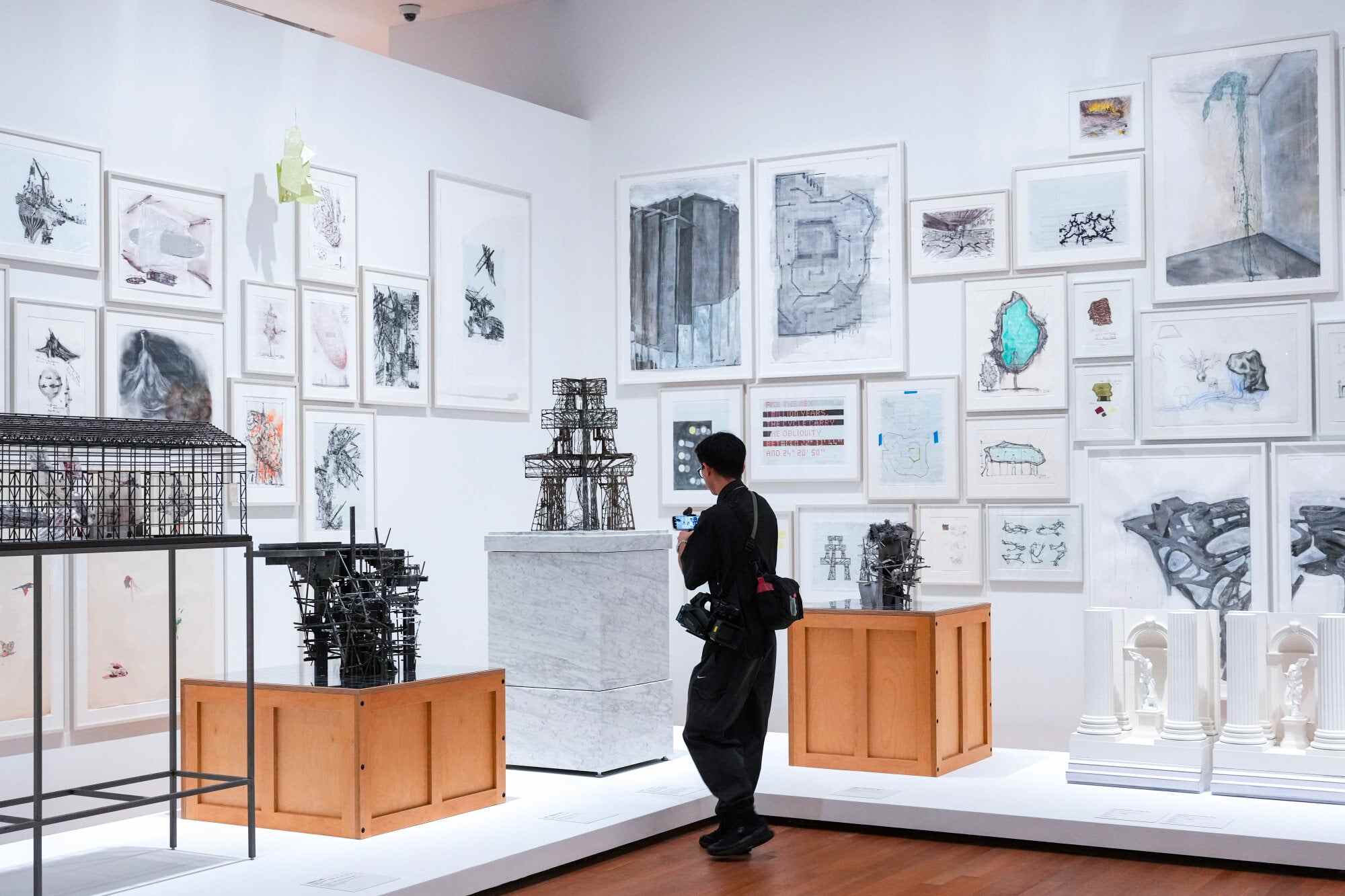
The final section, “Inside the Artist’s Mind”, looks at Lee’s creative process with about 100 drawings and dozens of precise maquettes – scale models or rough drafts – of sculptures, installations and other pieces.
A chance to visit Lee’s ‘multilayered’ world
The exhibition was co-organised by M+ and Leeum Museum of Art in Seoul, Korea. It received enthusiastic public and critical acclaim during its premier presentation in Seoul from September 2025 to January 2026.
“We are proud to partner with Leeum Museum of Art, Seoul, and present the most comprehensive survey of Lee Bul’s practice in Asia to date,” said Suhanya Raffel, the museum director at M+.
Lee Seo-hyun, the director of the Leeum Museum of Art, called the comprehensive survey “a multilayered world built from fragments of the past” that invited reflection.
“This collaboration amplifies both her legacy in Asia and her voice as a central figure in global contemporary art capable of resonating with global audiences,” he said.
Before its transition to an electoral democracy in the late 1980s, South Korea was under a military dictatorship. Lee’s parents were politically active, and she and her family were repeatedly uprooted and relocated.
“The artist is very transparent about this background,” the Leeum Museum director said. “However, she does not find her personal political views relevant to her work. Her art isn’t about ‘politics’ in a narrow, partisan sense; she is interested in a much larger, long-term view of human history.”
“Lee Bul: From 1998 to Now” is on view until August 9. Following its presentation in Hong Kong, the exhibition will travel to Belgium and Canada, before concluding in 2027.