Read the following text and answer the quiz below.
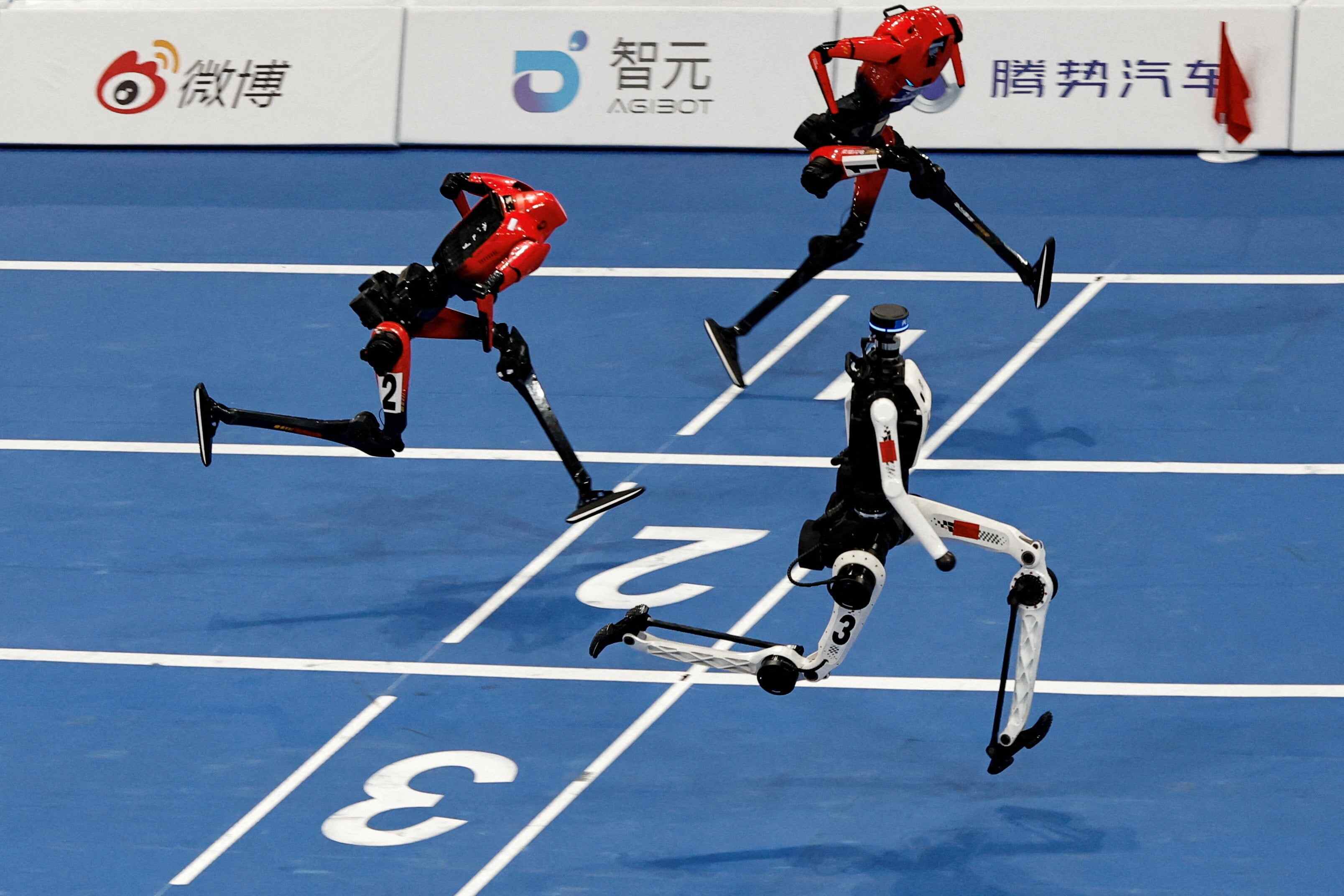
[1] Faceless humanoids delighted hundreds of viewers at the World Robot Games in Beijing last month. China showcased its dominance in the industry as the robots broke human records in the country’s capital. Dozens of humanoids and their human operators descended on Beijing’s Olympic speed skating arena to compete in events such as athletics, boxing, football and martial arts.
[2] During the event’s opening ceremony, a Chinese robot broke Jamaican legend Usain Bolt’s record for the 100-metre dash. The feat was splashed across headlines in Chinese state media. Tiangong Ultra – a white, headless humanoid – finished the sprint in 9.39 seconds, according to state broadcaster CCTV. This surpassed Bolt’s best of 9.58 seconds, set in 2009.
[3] The robot was developed by a local government-backed research centre in Beijing. It also shattered the 400-metre world record by nearly five seconds. It finished in 38.16 seconds – later revised to 38.15.
[4] In one 400-metre heat, a white-shelled robot thrashed its arms side to side as it propelled itself around the track. As it leaned dangerously forward, fans wondered aloud if it would fall. The robot wobbled as it stormed towards the finish but managed to remain upright.
[5] Fans were just as pleased to watch the robo-athletes flop, as multiple robotic runners failed to start. Others made their way around the track at the pace of a brisk walk or crumbled immediately after the gun start. Children and their parents giggled as a toddler-sized robot kicked a football off the pitch over knee-high barricades. Each clunky, barely defended goal earned the waddling humanoids roars of applause from the stands.
[6] Spectators erupted into laughter as a humanoid in a boxing ring stumbled off to the side and folded over the ropes, where it stayed motionless until humans lifted it away.
[7] The weekend’s robot records left 72-year-old spectator Hou Yali wanting to watch the machines go against humans. “We’ll be able to see more clearly whether machines can surpass humans,” said Hou, who is retired. “Right now, this is just running … a competition of speed. It’s not a test of intelligence or hiring someone to do household tasks,” she said.
[8] Hou pays people to clean her home and make meals for her weekly. She said she would like to see robots do those tasks. “People have more money in their pockets, and they may decide to use robots,” she said.
Source: Agence France-Presse, August 23
Content provided by British Council