One third of the world’s population was exposed to extremely high levels of ozone pollution this year, a European Union report said last month. This was due to a combination of heatwaves, wildfires and human-caused emissions.
Record-breaking conditions
The Copernicus Atmosphere Monitoring Service (CAMS) is the European Union’s Earth observation programme. It analysed the first eight months of 2026. The report highlighted the relationship between climate change and air pollution.
Record-breaking heatwaves and wildfires contributed to this year’s ozone pollution.
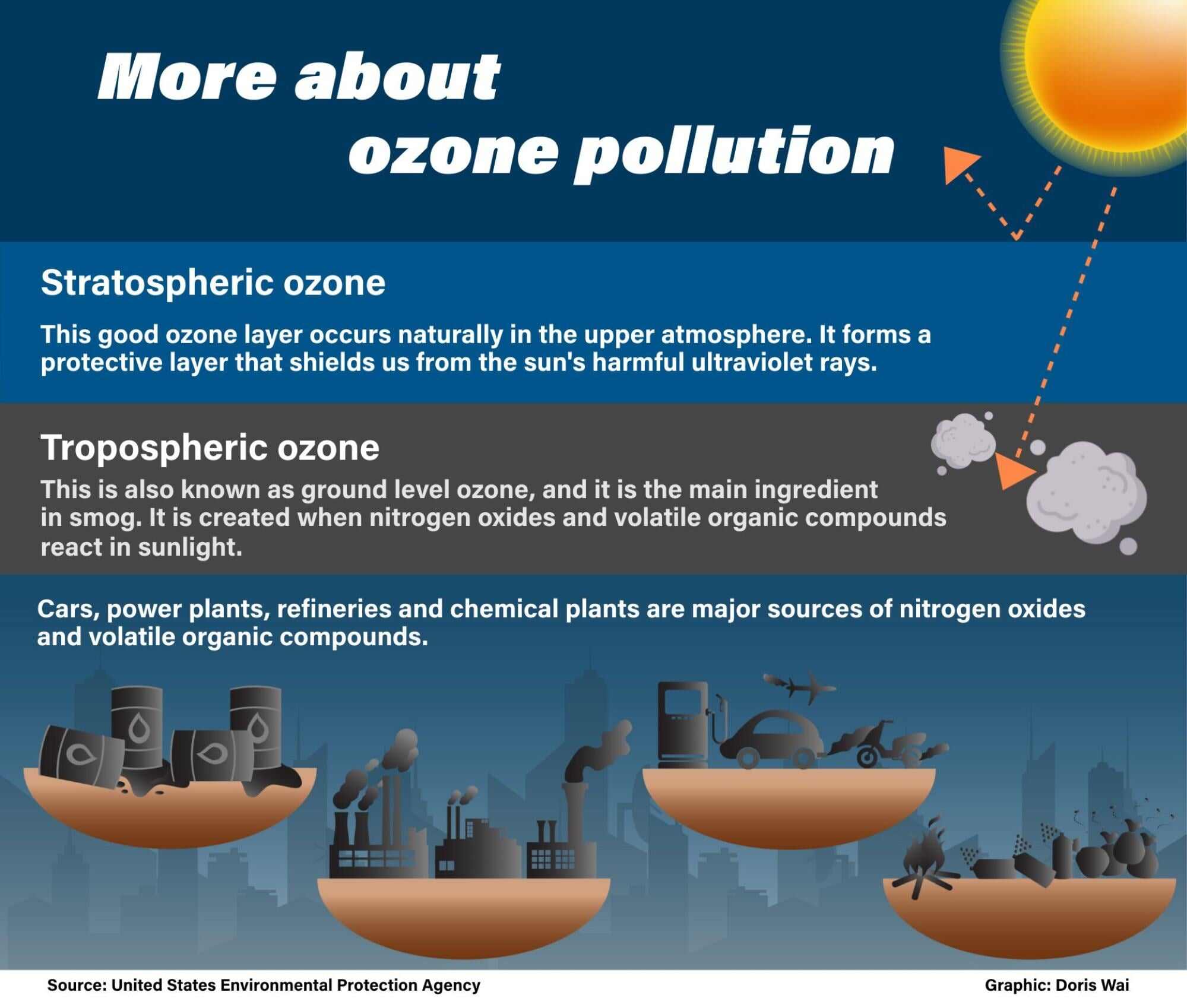
Heat and sunlight react with airborne emissions from wildfires, vehicles and industry. This creates ground-level ozone pollution (see graphic).
The pollution damages lung tissue, causes breathing problems and triggers asthma attacks. It also leads to other health issues.
El Nino could cause even more fires in Southeast Asia. For months, Indonesia has had major blazes. They have brought toxic haze to the country, as well as Malaysia, Singapore and parts of the Philippines for weeks.
“Air pollution does not stop at borders,” said Laurence Rouilin in the Atmosphere Watch report. She is the director of CAMS. “It can travel thousands of kilometres, crossing continents and oceans.”
‘Extremely poor’ quality
The report studied air quality from January 1 to September 15, 2026. It found that 34 per cent of the global population had been exposed to “extremely poor” air. This means the concentrations of ozone were well above World Health Organization guidelines.
Another 17 per cent of the world breathed “very poor” air. Five per cent was exposed to “good” levels of ozone.
Asia has the highest rate of exposure to ozone pollution. Around 53 per cent of the continent breathes “extremely poor” air. Another 22 per cent were exposed to “very poor” ozone. New Delhi in India, Dhaka in Bangladesh, Chongqing in China, and Lahore in Pakistan were among Asian cities with “extremely poor” ozone levels.
Two thirds of North America’s population were exposed to “poor” or “very poor” air quality. In Europe, 45 per cent breathed “poor” or “very poor” air. The report said the EU had effectively reduced emissions from air pollutants, except for ozone.
In Africa, forest fires and crop burning have contributed to air pollution. Saharan dust travels as far as Europe. Eight per cent of Africa’s population breathed “extremely poor” air this year. Another 19 per cent were exposed to “very poor” or “poor” air.
Ozone levels were very high in the Brazilian city of Sao Paulo and extremely elevated in Rio de Janeiro. But the air quality was “good” or “fair” for 81 per cent of South America’s population.
One bright spot was Oceania, which includes Australia and New Zealand. At least 66 per cent of the population enjoyed “good” ozone levels.