
Deep Dive delves into hot issues in Hong Kong and mainland China. Our easy-to-read articles provide context to grasp what’s happening, while our questions help you craft informed responses. Check sample answers at the end of the page.
News: Rising number of Chinese graduates opt for gig work
-
The share of university graduates seeking flexible jobs rose by 2.7 percentage points over the last five years
-
These graduates continue to face a tough job market
China’s university graduates are opting for flexible work while pursuing higher degrees less frequently, according to a Beijing-based education consultancy. Additionally, starting salaries are not growing as quickly as the national averages for overall salaries.
Over the past five years, the share of university graduates seeking flexible jobs rose by 2.7 percentage points to 6.9 per cent, from 4.2 per cent in 2021. This trend is particularly noticeable among graduates from vocational colleges, according to the MyCOS Research Institute.
The country’s university graduates, estimated at 12.7 million in 2026, continue to face a challenging job market.
The report stated that only 3.4 per cent of graduates took graduate school admission examinations before securing jobs, a decrease from 5.6 per cent in 2023.
After graduating in 2025, 63 per cent of jobseekers moved to relatively small cities at or below the prefecture level, up from 58 per cent in 2021.
“The traditional one-way flow patterns of following the trend for further studies and preferring first-tier cities are gradually being broken, replaced by more pragmatic and diversified career paths,” MyCOS said.
The report revealed that graduates from last year were earning 7.7 per cent more in starting pay compared with the class of 2021, after adjusting for inflation. Last year’s graduates earned an average starting salary of 6,435 yuan (HK$7,446) per month. Income for vocational college graduates increased 5.8 per cent over the same five years to 4,882 yuan per month, according to the institute’s 2026 China College Graduates Employment Report.
Their pay was higher than the national average disposable income of 4,709 yuan per month for urban residents.
But these increases are relatively modest when compared with overall wage growth in urban areas. National Bureau of Statistics data showed that last year’s urban non-private sector pay rose by 14.2 per cent over 2021, while private sector pay increased 9.8 per cent.
Spending was unlikely to keep pace with recent growth in starting salaries, said Gary Ng, a senior Asia-Pacific economist at the French investment bank Natixis.
“A lot of people are still worried about their future and are saving up for rainy days,” he said.
Among last year’s graduating class, 14.2 per cent were working in education, 9.3 per cent in software and information technology and 7 per cent in electronic and electrical equipment manufacturing – the top three sources of employment, according to MyCOS.
Staff writers
Question prompts
1. Which of the following statements is false, according to the information in News?
(1) University graduates from the 2025 class were making a lower starting pay compared with those from 2021.
(2) Sixty-three per cent of jobseekers who had graduated last year chose to live in smaller cities.
(3) University graduates were paid significantly less than the national average disposable income for urban residents.
(4) The majority of 2025 graduates are employed in education, information technology and electronics manufacturing.
A. (1), (2) only
B. (1), (3) only
C. (2), (4) only
D. (3), (4) only
2. Based on your understanding of News, why do you think more Chinese graduates are living in smaller cities?
3. How have starting salaries for different graduates changed in the past five years? Will this lead to a change in people’s spending? Explain.
Graph
Question prompts
1. Using the chart, note TWO observations about the youth unemployment situation in China from 2018 to 2026.
2. What impacts do you think the unemployment trend in China will have on the country’s gig economy in the long term? Explain using News, Glossary and your own knowledge.
Issue: Is China’s gig economy drying up?
-
Gig workers in the country are experiencing issues with unstable income and a lack of social security
-
Many people who cannot find full-time work in cities are turning to gig work to stay afloat
Yu Shutian is a 30-year-old actress who frequently travels and has short rest periods, which are an unavoidable part of her daily routine. She works in the country’s fast-growing micro-drama industry and experiences a constant anxiety about survival.
“In an era where small actors can be quietly replaced at any moment by [artificial intelligence], having work is a form of salvation,” she said.
Yu, who holds a master’s degree in directing from the University of Sussex, is just one of China’s more than 200 million gig-economy workers. In addition to the spectre of AI, many must deal with unstable income and a relative lack of social security protections.
The gig economy, encompassing ride-hailing drivers, food delivery couriers, digital content creators and many other roles, has evolved from a side hustle into a vast reservoir absorbing the country’s unemployment pressures and helping maintain economic stability.
China’s micro-drama industry is now moving beyond its early phase of expansion into a fiercely competitive market, one that is now facing disruptions from AI.
In recent years, the industry’s low barriers to entry and rapid production cycles made it an important fallback option for unemployed young people, mainstream film workers out of a job and even fresh graduates. But AI-generated productions are now upending that model.
As of 2024, the number of flexibly employed people in China exceeded 240 million, according to a report by People’s Tribune, a magazine affiliated with People’s Daily, the official newspaper of the ruling Communist Party.
Food delivery riders nationwide had surpassed 10 million, and the number of professional live-streamers had reached 38.8 million, it said, citing figures from the National Bureau of Statistics (NBS).
The State Council, China’s cabinet, in April rolled out a plan for stronger labour protections for gig workers.
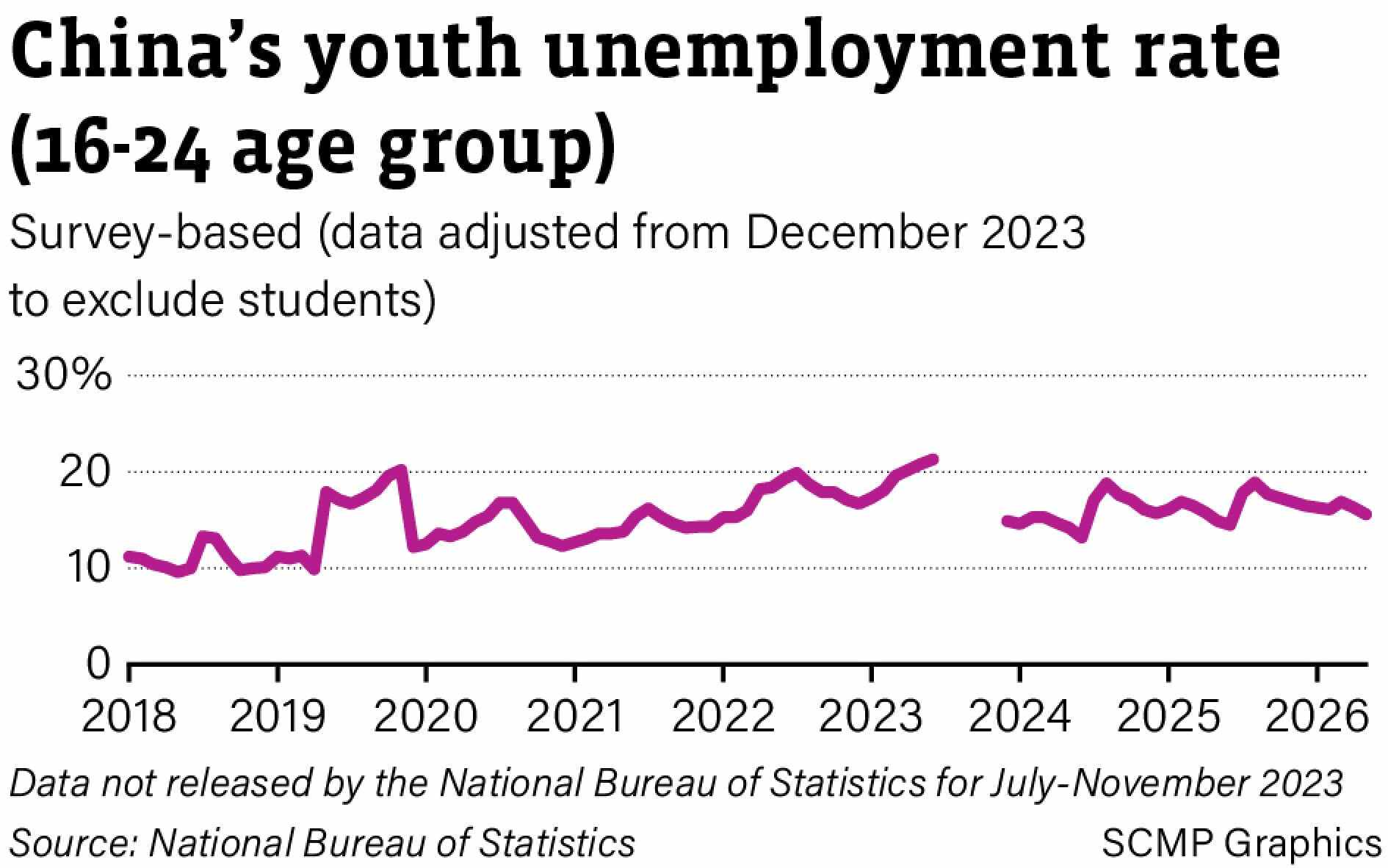
According to official data, youth unemployment in urban areas remains high. In April, the NBS reported a 16.3 per cent jobless rate for people aged 16 to 24 and 7.4 per cent for the 25 to 29 age group, both excluding students.
The expanding role of the gig economy as a labour “reservoir” has alarmed some economists.
Li Shi, dean of the Institute for Common Prosperity and Development at Zhejiang University, noted the gig workforce had effectively replaced rural villages as the country’s main urban employment buffer – those who previously returned to their hometowns if unable to find work are now staying in cities to seek temporary positions.
He warned that China risks deepening “employment polarisation”, where stable middle-income jobs shrink. At the same time, workers become concentrated in either high-skilled or precarious, low-paid work, prolonging weaknesses in the country’s household consumption.
“The employment situation is severe. Flexible employment and new employment groups are expanding, but unstable job expectations among them create a new form of pressure,” Li told Caijing magazine.
Staff writers
Question prompts
1. What are the problems currently confronting gig workers in China?
2. Why have more gig workers been joining the micro-drama industry?
3. According to Li Shi, how are the changes in China’s gig economy related to the phenomenon of employment polarisation?
Illustration
Question prompts
1. What is being shown in the illustration, and how does it relate to the information in Issue?
2. Based on the illustration, suggest ONE way authorities can create more stability for gig workers. Explain using News, Glossary and your own knowledge.
Glossary
-
prefecture level: an administrative region in China that ranks below a province. The biggest prefecture-level cities include Beijing, Shanghai, Guangzhou and Shenzhen, which are often unofficially called “first-tier” cities. There are also dozens of other prefecture-level cities that are relatively smaller than these “first-tier” cities.
-
overall urban wage growth: the average rate at which the salaries of city-dwelling workers increase over a specific period, typically tracked on an annual basis
-
national average disposable income: the average “take-home pay” for spending or saving after deducting all taxes and mandatory social security contributions. It reflects a population’s true purchasing power and standard of living.
-
social security: government-mandated safety nets, such as health insurance and pensions, designed to provide financial security during sickness or old age. Voluntary withdrawals from the public pension system are becoming more common among sections of China’s flexible workforce. With the country gradually raising its retirement age after recent reforms, many lower-income workers prefer to keep cash flow for immediate survival rather than cover a retirement that is decades away.
-
labour protections: a 12-point plan that calls for timely and fair wage payments, a stronger social security system, better labour protections in extreme weather and more transparency in how platforms’ algorithms allocate orders and fees, among other measures
-
urban employment buffer: a safety net that absorbs unemployed workers during economic downturns to prevent mass unemployment in cities
Sample answers
News
1. B
2. New graduates might prefer living in smaller cities because they may offer more practical and diverse career paths and opportunities. In addition, the cost of living is generally lower than in Tier 1 cities, which is important because although starting wages have risen in the last few years, average pay has not. Living in a smaller city could help people save money. (accept all reasonable answers)
3. According to reports, starting salaries for university graduates in 2025 were 7.7 per cent higher than those for the class of 2021; the same is true for those who attended vocational school. However, Gary Ng, a senior Asia-Pacific economist at Natixis, suggested that people’s spending is unlikely to change despite these increases in starting salaries. This reluctance may stem from the instability of the job market in recent years, leading many individuals to feel uncertain about their futures and prefer saving for potential downturns. (accept all reasonable answers)
Graph
1. First, the graph indicates a steady rise in youth unemployment in China over the period from 2018 to 2026. Second, the highest levels of youth unemployment tend to occur in the middle of each year.
2. The persistently high youth unemployment rate is likely to increase the size of the gig economy and could fundamentally change its role within the labour market. As more people enter the gig economy, this sector may become the primary employment buffer for urban areas in the long run. The younger workforce may come to accept precarious, low-paid gig work as a permanent substitute for the diminishing availability of stable middle-income jobs.
Issue
1. Gig workers in China currently face issues like unstable income, limited social security protections and potential disruptions from AI.
2. More gig workers have been joining the micro-drama industry because the sector has relatively low barriers to entry and quick production cycles. This makes it an appealing backup option for unemployed young people, mainstream film workers who are out of work and even recent graduates. (accept all reasonable answers)
3. According to Li Shi, changes in China’s gig economy are closely linked to employment polarisation. This phenomenon occurs when stable middle-income jobs diminish, leading to a concentration of workers in either high-skilled positions or precarious, low-paying jobs. As these stable middle-income roles disappear, an increasing number of graduates and other workers are compelled to seek opportunities in the gig economy. Additionally, recent news indicates that overall wage growth for urban workers has risen significantly more than starting salaries. This trend suggests that individuals in high-skilled, full-time jobs are receiving better compensation, further contributing to the widening gap between income extremes. (accept all reasonable answers)
Illustration
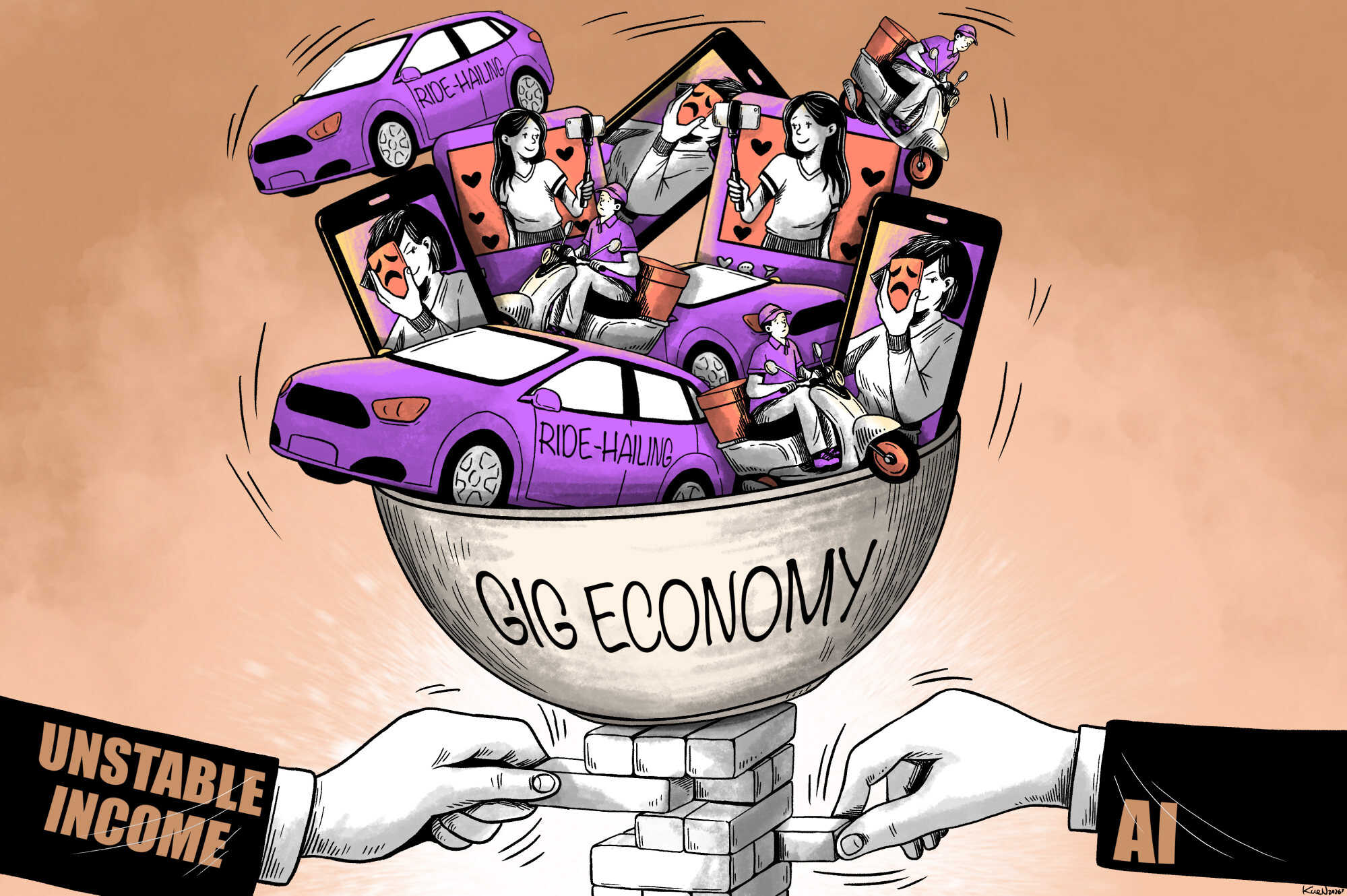
1. Digital content creators, ride-hailing services and food and package delivery are the major components of the gig economy. However, gig workers are facing significant challenges and an uncertain future due to income volatility and the impact of AI adoption.
2. Given the unique characteristics of gig work, where income is based on tasks rather than a fixed hourly rate, a traditional flat monthly minimum wage may not effectively protect gig workers. Instead, Chinese authorities could establish a legally protected minimum payout per delivery, per hour of active app time or even per job task. These rates should be adjusted based on city tiers to address differences in living costs and ensure fairness. This approach would create a more flexible and responsive safety net, helping gig workers maintain a basic level of financial stability despite market fluctuations. (accept all reasonable answers)