Deep Dive delves into hot issues in Hong Kong and mainland China. Our easy-to-read articles provide context to grasp what’s happening, while our questions help you craft informed responses. Check sample answers at the end of the page.
News: China looks for new treatments for Alzheimer’s, Parkinson’s
-
Researchers are exploring new ways to treat symptoms of these conditions
-
Cases of both diseases are expected to rise as China’s population continues ageing
China is stepping up efforts to find new treatments for Alzheimer’s disease and Parkinson’s disease.
As its population ages, the country already has more cases of these neurodegenerative diseases than anywhere else in the world. These are conditions that destroy parts of your nervous system, especially your brain. Rates in China are rising faster than the global average.
Cases of Parkinson’s disease in China are forecast to rise from 3.6 million in 2024 to 10.5 million in 2050. Between 69 million and 92 million people will have Alzheimer’s disease by this time. Both diseases mainly affect the elderly. China had 320 million people aged 60 and over at the end of 2025.
Chinese researchers are working to develop new Western medicines to treat the symptoms of these diseases. They are also exploring the potential of formulas and ingredients from traditional Chinese medicine (TCM) to complement or replace conventional drugs.
A national project backed by institutes under the Chinese Academy of Sciences was launched in March. The project aims to accelerate the development of original treatments for Alzheimer’s disease.
The global market for Parkinson’s drugs is expected to grow from US$6.1 billion in 2025 to US$9.2 billion (HK$47.8 billion to HK$72 billion) by the end of 2030, according to Boston-based BCC Research. The market for Alzheimer’s drugs is expected to be worth US$13.1 billion (HK$102.6 billion) by this time.
Alzheimer’s and Parkinson’s are both associated with changes in the brain caused by abnormal protein build-ups. Oxidative stress occurs when the brain’s antioxidant defences break down. This can contribute to the build-up, as can the inflammation of nervous tissue.
In Parkinson’s disease, certain protein clumps lead to the death of nerve cells that produce dopamine. Meanwhile, Alzheimer’s disease is caused by protein build-ups blocking the brain’s communication channels.
Imbalances in the gut microbiome contribute to inflammation through signals transmitted via the body’s gut-brain axis. This network links the gastrointestinal tract – the major organs of the digestive system – and the central nervous system.
Hong Kong scientists have investigated links between this and the onset of Parkinson’s: “This research allows us to ... map the disease progression, which may tell us how we can prevent [it],” said Professor Wing Yun-kwok, chairman of the Chinese University of Hong Kong’s department of psychiatry.
Staff writers
Question prompts
1. Which of the following statements is false, according to the information in News?
(1) Alzheimer’s is caused by a blockage of the brain’s communication channels.
(2) The rate of Parkinson’s disease in China is rising more slowly than the worldwide average.
(3) The global market for drugs to treat Parkinson’s is expected to drop by the end of 2030.
(4) Parkinson’s disease causes slowing and loss of movement and digestive problems.
A. (1), (2) only
B. (1), (3) only
C. (2), (3) only
D. (3), (4) only
2. What TWO problems can lead to the build-up of proteins in the brain, according to News?
3. Why is China prioritising the development of new treatments for Alzheimer’s and Parkinson’s disease? Explain using News, Glossary and your own knowledge.
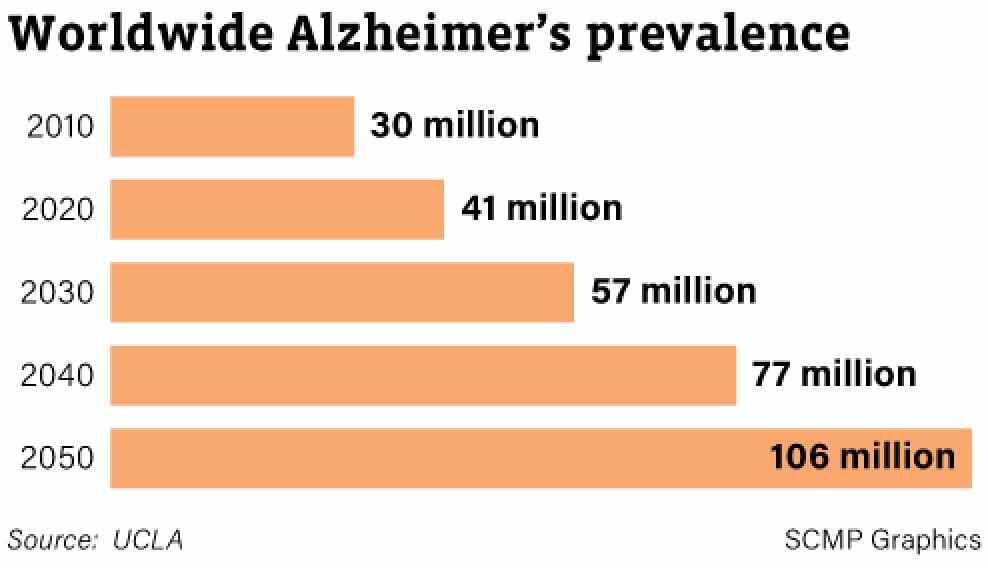
Chart 1
Question prompts
1. List ONE observation regarding the prevalence of Alzheimer’s disease worldwide.
2. What impact could an increase in Alzheimer’s cases have on China and the world? Explain using News, Glossary and your own knowledge.
Issue: How does TCM play a part in treating neurodegenerative diseases?
-
Experts say traditional Chinese medicine shows promise in treating Alzheimer’s and Parkinson’s, especially alongside Western drugs
-
Multi-ingredient formulas are hard to isolate, prompting scientists to use computer modelling and nanotechnology for better delivery
While pursuing Western medical breakthroughs, researchers in China and elsewhere have also focused on the potential of ingredients and formulas used in traditional Chinese medicine (TCM) to treat symptoms of Parkinson’s and Alzheimer’s.
However, scientists face a challenge.
“Traditional Chinese medicines often contain multiple ingredients that work [together], making it difficult to isolate specific active compounds,” said Dr Fanny Ip Chiu-fun, chief scientific officer of the Hong Kong Centre for Neurodegenerative Diseases.
For example, one common TCM formula, zhen gan xi feng tang, has 12 ingredients. These contain 139 active components that act on 119 Parkinson’s disease-related targets in the human body, according to a recent study by researchers at Sichuan University and People’s Hospital of Leshan in China’s southwestern province of Sichuan.
Researchers noted that clinical studies have shown that the formula, when prescribed with Western drugs levodopa and benserazide, significantly improves symptoms in Parkinson’s disease patients.
Meanwhile, researchers at Guangdong Provincial Hospital of Chinese Medicine in southern China reported that prescribing anti-Parkinson’s drugs with a concoction of TCM ingredients “showed superior effects”.
Similar studies suggest various other TCM formulas have or could have beneficial effects on Alzheimer’s and Parkinson’s, either on their own or administered with conventional drugs.
Chinese researchers have sought to identify how the active components in TCM ingredients might treat or prevent neurodegenerative diseases.
A 2024 paper, published by researchers at Heilongjiang University of Chinese Medicine in Harbin, northeast China, details the properties and potential impacts on Parkinson’s symptoms of 36 ingredients and five TCM formulas identified using computer analysis and modelling.
A dozen of the ingredients and formulas they found could reduce oxidative stress, also a factor in Alzheimer’s. They recommended follow-up tests in the laboratory and on live subjects.
Meanwhile, scientists at Ningbo University in China’s eastern Zhejiang province explored the potential of four common components of Chinese medicine to counter Alzheimer’s disease.
They found multiple ways to reduce or prevent toxic protein build-ups, inflammation and oxidative stress in the brains of rats and mice.
A constant refrain in these and similar research papers is the need to conduct rigorous clinical trials.
Randomised controlled trials are the gold standard for these, and a recent review of 45 such trials found 37 had shown natural compounds or supplements improved cognitive outcomes.
The scientists at Ningbo University who explored the use of TCM components to treat Alzheimer’s studied the use of nanoparticles as carriers to deliver therapeutic molecules to the brain. They tested their use intravenously, by injection and via the nose-to-brain route of nasal sprays to bypass the blood-brain barrier.
“Nanoparticle drug delivery systems hold the potential to revolutionise the treatment of neurological disorders like Alzheimer’s disease by improving drug efficacy, safety and targeted delivery,” they wrote.
Staff writers
Question prompts
1. What is the primary difficulty scientists face when trying to analyse and isolate how traditional Chinese medicine formulas work?
2. According to Issue, how does combining the zhen gan xi feng tang formula with conventional Western drugs affect Parkinson’s patients?
3. How are researchers proposing to use nanotechnology to overcome the physical and structural barriers of delivering traditional medicine components to the brain?
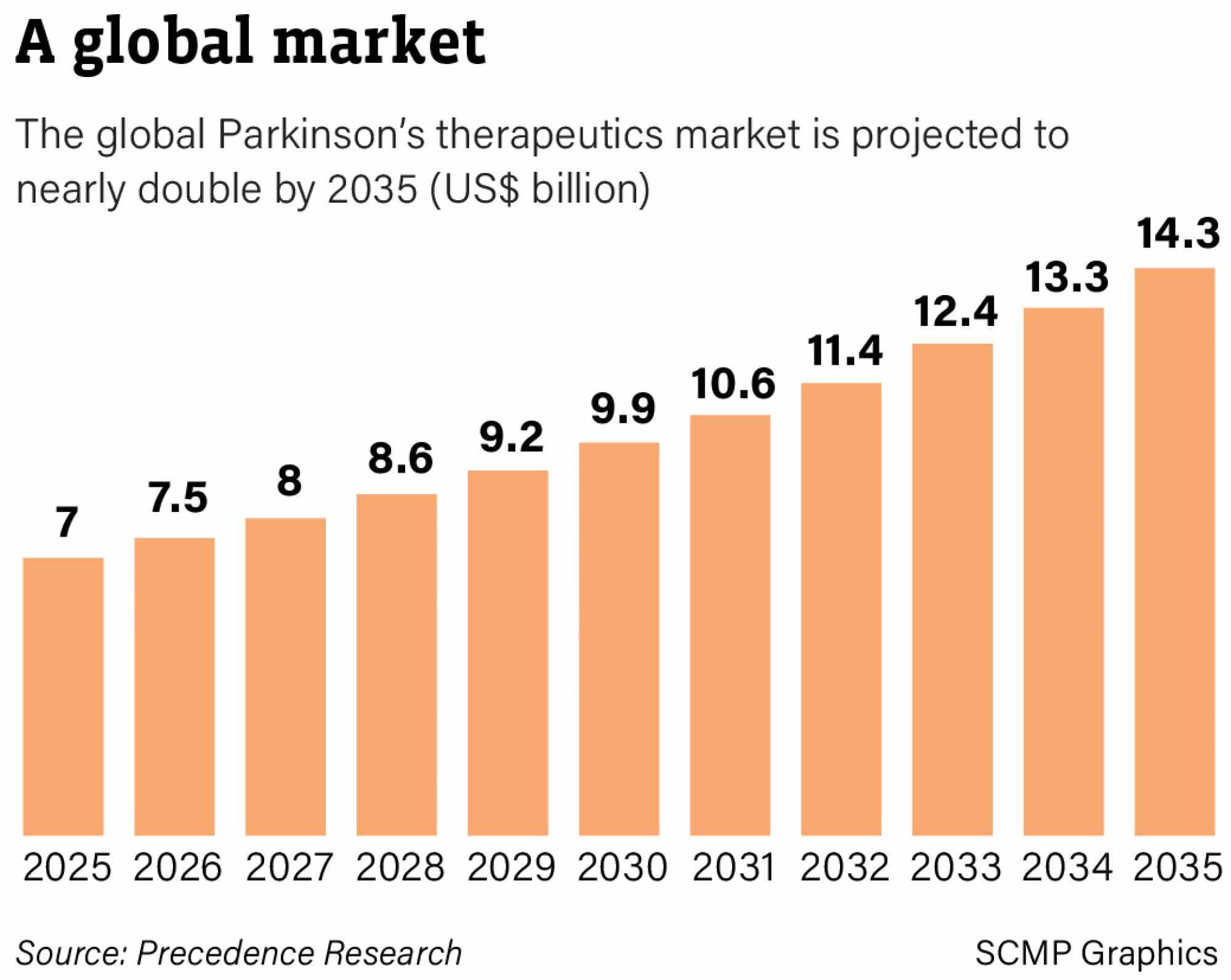
Chart 2
Question prompts
1. In which specific year is the global Parkinson’s therapeutics market projected to reach the US$10 billion mark?
2. Looking at the overall trend from 2025 to 2035, how does the steady year-on-year increase in market size reflect the need for new treatments? Explain using News, Issue, Glossary and your own knowledge.
Glossary
-
Alzheimer’s disease: a disease that slowly kills brain cells. It affects different parts of the brain, but has its most severe effects on the areas that control memory, language and thinking skills.
-
Parkinson’s disease: a disease that slowly damages the central nervous system. Symptoms of this disease include slowing and loss of movement, involuntary shaking of the hands, feet and jaw, trouble swallowing and digestive problems.
-
oxidative stress: an imbalance of free radicals – unstable molecules – and antioxidants in your body that leads to cell damage
-
gut microbiome: the complex community of microorganisms, including bacteria, fungi and viruses, living in the digestive tract
-
zhen gan xi feng tang: a multi-ingredient traditional Chinese medicine formula used to treat various issues, including symptoms of neurological disorders like Parkinson’s disease
Sample answers
News
1. C
2. Two problems that can lead to abnormal protein build-ups in the brain are oxidative stress and the inflammation of nervous tissue.
3. China is prioritising the development of new treatments primarily because of its rapidly ageing population, a demographic shift that is driving a surge in age-related neurodegenerative diseases, which could burden the country’s healthcare system. Currently, China has more cases of Parkinson’s and Alzheimer’s than anywhere else in the world, and these rates are climbing faster than the global average. If researchers can find new treatments for these diseases, people can be more independent as they age, reducing the burden on the healthcare system. / There is also an economic incentive. The global markets for Parkinson’s and Alzheimer’s drugs are projected to reach US$9.2 billion and US$13.1 billion respectively by 2030. Developing original treatments through state-backed national projects allows China to capture a lucrative share of this growing global market. / Furthermore, by exploring traditional Chinese medicine (TCM) alongside Western methods, China is leveraging its unique cultural heritage to potentially create accessible treatments for its citizens, thereby reducing its reliance on foreign pharmaceutical imports. (accept all similar answers)
Chart 1
1. The worldwide prevalence of Alzheimer’s disease is projected to experience continuous and dramatic growth over a 40-year period, more than tripling from 30 million cases in 2010 to an estimated 106 million cases by 2050. (accept all similar answers)
2. An increase in Alzheimer’s cases could burden healthcare systems and families. Because it is a neurodegenerative disease destroying parts of the brain, patients require intensive, long-term care, straining public and private budgets as well as availability of carers. / This public health crisis could accelerate global medical innovation. Soaring demand is driving the Alzheimer’s drug market towards an estimated US$13.1 billion by 2030. This incentivises governments and institutes to fund research for treatments for these diseases. (accept all similar answers)
Issue
1. The primary difficulty is that traditional Chinese medicine formulas often contain multiple ingredients that work together. This complex combination makes it highly challenging for scientists to isolate and identify the specific active compounds responsible for the therapeutic effects.
2. Combining the zhen gan xi feng tang formula with levodopa and benserazide significantly improves symptoms in Parkinson’s disease patients.
3. Researchers are trying to create special nanoparticles to carry traditional Chinese medicine molecules to the brain. This method can bypass the blood-brain barrier, and scientists are testing this nanotechnology through injection and nasal sprays. This method could make the delivery of the drugs more targeted, enhance the drug’s effectiveness and make treatment safer for patients.
Chart 2
1. The global Parkinson’s therapeutics market is projected to surpass the US$10 billion mark by 2031.
2. The steady market growth from US$7 billion to US$14.3 billion reflects an escalating global demand driven by the ageing population in many countries. With Parkinson’s cases in China alone forecast to triple to 10.5 million by 2050, conventional drugs are struggling to meet the needs of a surging patient base. This financial expansion calls for medical innovation. The growing market value provides the necessary economic incentive for institutions like the Chinese Academy of Sciences to fund intensive research. This capital enables scientists to develop next-generation solutions, combining conventional Western pharmaceuticals with traditional Chinese medicine (TCM) and innovations in nanotechnology.