Have something to say? Send us a letter using this form.
Gender equality and teens
Elise Sze, Chinese International School
Until recently, I thought gender equality was an adult issue, at least in Hong Kong. I associated it with salaries, boardrooms and office policies.
These are important debates, but ones that didn’t seem to have much to do with me as a teenager.
I hadn’t really considered how much gender can shape our experiences and opportunities long before we ever enter the workplace.
Then, through my podcast, I started interviewing inspiring women and organisations working on gender equality, which made me much more aware of the work being done in Hong Kong by groups such as The Women’s Foundation and the Equal Opportunities Commission (EOC). I learned about the incredible progress being made across different sectors.
For example, in 2022, the Hong Kong stock exchange effectively banned single-gender boards for listed companies; now every board must include at least one female director. I also discovered that in higher education programmes funded by the University Grants Committee, women now slightly outnumber men for the first time.
These are great steps forward, but there’s still work to be done. As I have learned, these issues also begin much earlier than adulthood. They can affect school subject selections, career ambitions, relationships, family expectations and the confidence to speak up.
Perhaps it is not surprising that teens can feel disconnected from the topic. Much of the conversation can sound legal, institutional, or workforce-focused. This made me ponder how I could make the topic feel more relevant and accessible to young people, like my friends and me, who care about inequality but may not be aware of the subtle ways it can manifest in homes and schools across the city.
That question led me to create Equalish, a collaborative board game for teenagers about gender equality in Hong Kong.
Players choose different career paths and move towards the CEO position, picking up event cards that introduce real-life situations where inequality can arise, from education and care responsibilities to harassment and workforce barriers.
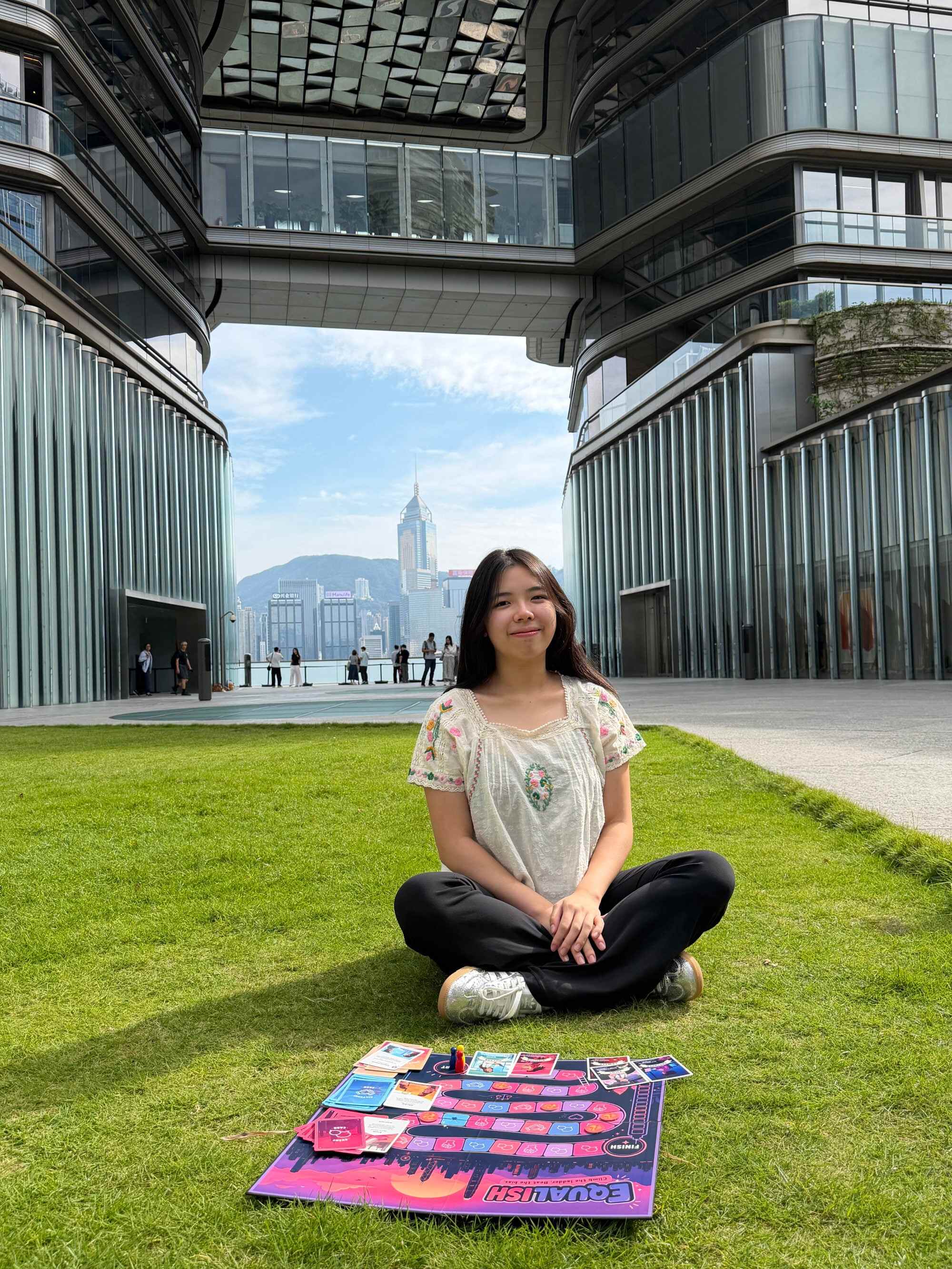
Empowerment cards contain real information about rights and protections in Hong Kong that can help players overcome setbacks, and allyship cards are used to help other players rather than yourself.
Rather than competing against other players, everybody needs to work together: shared victory cannot be claimed until everyone has smashed through the “glass ceiling” checkpoint. Ultimately, the game embodies the message that equality will never come from individual success alone.
While building the board game, I spent hours researching rights and protections in Hong Kong, thinking about how inequality manifests in everyday situations and exploring what useful responses and allyship look like.
I learned an enormous amount from this process, and I am now trying to distribute Equalish to schools, youth groups and NGOs in Hong Kong so that others can learn from it too.
I hope it can be used in classrooms and community settings as a starting point to spark discussion.
Preserving Cantonese culture
Yolanda Chan, Carmel Secondary School
I am writing in response to an opinion piece published in the South China Morning Post on October 5 titled “Hong Kong can speak better Mandarin but not at the expense of Cantonese”.
As a Form Six student counting down the days at my beloved secondary school, I was dumbfounded and dismayed to learn that Good Hope School prohibited the use of Cantonese in graduation videos.
I wholeheartedly agree with Alice Wu, the writer of the piece. Cantonese is an irreplaceable pillar of our cultural identity and a heritage worth safeguarding.
Cantonese is a core component of local identity and should be preserved. It is part of Hong Kong’s rich cultural heritage, which has spread around the world.
During an exchange trip to Hunan last year, my classmates and I had a music lesson with students from Changjun High School.
We found out that many of them enjoyed the song “Boundless Oceans, Vast Skies” by the famous Hong Kong band Beyond. The lesson ended with a warm rendition of the hit, building a bond between the students.
Hong Kong films, dramas and music are enjoyed and appreciated by many non-locals even today, and Cantonese is regarded as the cornerstone that differentiates Hong Kong culture and makes it special.
That experience in Hunan made me realise that Cantonese culture remains a powerful global legacy, yet its survival depends on whether we value it in our own backyards. If non-local students can find beauty and connection in our mother tongue, it is deeply ironic that local schools are suppressing it.
Preservation of Cantonese should not mean turning it into a museum artefact to be mourned only after it is destroyed. Instead, there should be a visible effort to encourage and celebrate Cantonese while striking a balance with learning Putonghua.
Take the debate about whether schools should teach in Cantonese or Putonghua. A study conducted by the Education University of Hong Kong from 2012 to 2015 compared students learning Chinese with Cantonese or Putonghua.
The study showed that students were more active in lessons when teachers used Cantonese as the medium of instruction. It also showed greater alignment and fluency in writing Chinese sentences when Putonghua was used as the medium of instruction.
This proves that both Cantonese and Putonghua have distinct strengths and the two languages should not be polarised as mutually exclusive options.
The Good Hope School Incident serves as a wake-up call about what Cantonese means to all of us. While adaptations are necessary to fit modern language standards, they must not rob graduates of the emotional voices in their once-in-a-lifetime memories.